What to do when you feel like an imposter
It has been almost a year since the world changed. Can we even remember sitting in traffic or doing meetings in person? Do you feel like those were the good old days?
Many of us have been forced to pivot our careers – some by choice, others by circumstance. This rapid change in work (but also in all other facets of life) have left many feeling like they have no idea what they are doing. We get used to feeling like beginners when we are kids, purely because we have no other option. But somewhere later in life we fall in love with feeling competent, skilled and in control. It takes much less effort and energy to feel this way – so we decide to stick to our guns. But what happens when we don’t have that “luxury”?
Imposter syndrome is the experience of feeling like a phony—you feel as though at any moment you are going to be found out as a fraud—like you don’t belong in your new position, don’t know what you are doing, and you only got there through dumb luck. You might be a complete novice, or an expert in your field but it can affect anyone no matter their social status, work background, skill level, or degree of expertise.
You might be seeing yourself as an imposter when:
· You constantly doubt yourself;
· Talk yourself out of trying new things you really want to do;
· Underestimate your competence and skill;
· Attribute your success to outside factors, like luck;
· You struggle with perfectionism and fear you won’t meet expectations;
· You set unrealistic goals and feel disappointed when you don’t reach them.
If you were to draw a picture of what you’re experiencing, it would look something like this:
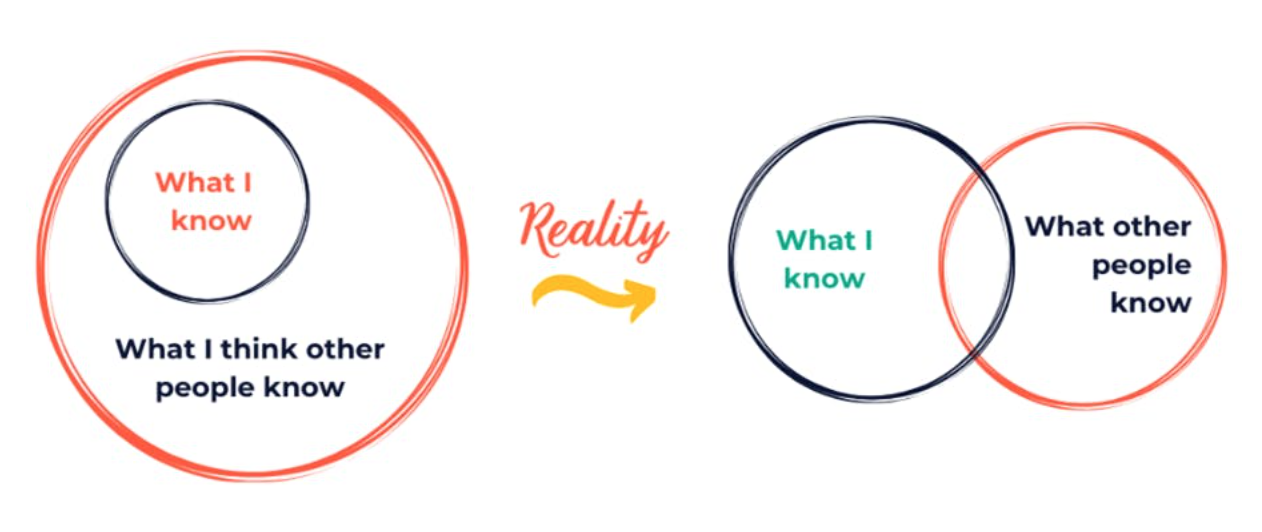
When we find ourselves in a new environment, role or position it’s natural to feel a little out of our depth. We feel like we know very little, while everyone around us seem to know exactly what they are doing. In reality, most people know as much as you do, but their experience and knowledge just differ from yours (with some level of overlap).
Now we obviously run the risk of overestimating our ability in some cases – particularly if we have some level of experience in a field. Take driving as an example. Have you ever heard someone admit that they’re a bad driver? Never! It’s always everyone else who’s the idiot. Let’s be honest, just because you’ve been driving for 30 years does not mean you have what it takes to take on Lewis Hamilton. Experience does not (necessarily) equal expertise. That’s why it is so important to have an accurate assessment of our ability level.
So, what can you do when you regularly find yourself making excuses for why you can’t do the things you know in your heart you should be going after?
In his new book Think Again, Adam Grant shares the following tips:
1. Use your feelings of being an imposter as motivation to work harder. Since confidence and previous successes can make us complacent, use your fear of letting others (and yourself) down as a positive drive towards honing your skills and improving your abilities.
2. Use your imposter thoughts to work smarter. Since you already think of yourself as a beginner, you are more likely to rethink your strategy (compared to those around you who know what they are doing). A fresh approach might be all you need to put you on the path to success.
3. Feeling like an imposter can make you a better learner. When you doubt your knowledge and skills you no longer have to prove that you know it all, making you more likely to seek out insights from others. “Learning requires the humility to realize one has something to learn.” – Elizabeth Krumrei Mancuso.
All of us have been told to “fake it till you make it” at some point in our lives. And this is not bad advice – IF 1) we are humble enough to know that we need to constantly enhance our skillset and 2) are disciplined enough to actually put in the work. Humility and hard work is a great combination towards success.
The Takeaway
Everyone will inevitably feel like an imposter. Every time you try something new or go after something important, that might be your natural reaction. There is so much untapped potential inside of you. So many things you still need to learn, accomplish, and contribute. Don’t let fear talk you out of becoming who you are meant to be. It might be time to start using the word “yet” a little more often.
I don’t know what I am doing…yet.
I don’t have the skill…yet.
In the meantime, don’t hold back. Put in the work. Learn as much as you can. But simply start – it’s the best way to learn.
In Closing…
Which aspects of life are proving to be the most challenging on a personal or professional level? Please let us know if there are any topics you would like to read more about. If you find the content of these newsletters meaningful, please share with anyone you think could benefit from it.
Taking these tough times into consideration and with the knowledge that people are under severe pressure, PurposeWorks has developed a series of workshops aimed at building resilience, enhancing emotional intelligence, managing and dealing with burnout and focusing on the importance of selfcare. Our aim is to provide practical, actionable advice, informed by the science of Positive Psychology in an accessible and affordable format.
Please contact us at hello@purposeworks.co.za for more information on how we can get involved in your environment.

At PurposeWorks we are all about Making You and Your Work Rock. Our focus is on Organisational Health and Design, Employee Centered Culture, Leadership Development and Performance Coaching. For more information on how we can help you create a work environment that rocks, develop a great team, become an inspiring leader or unlock your personal excellence talk to us at info@purposeworks.co.za.